DBD’s Killer vs. Survivor Divide: Why Both Sides Think the Game Is Unfair
Killer mains blame SWFs. Survivors blame tunneling. The real reason Dead by Daylight feels unfair may be buried much deeper in its 1v4 design.
Last updated: August 17, 2026
Written by Zachery McKinney | Redacted Games
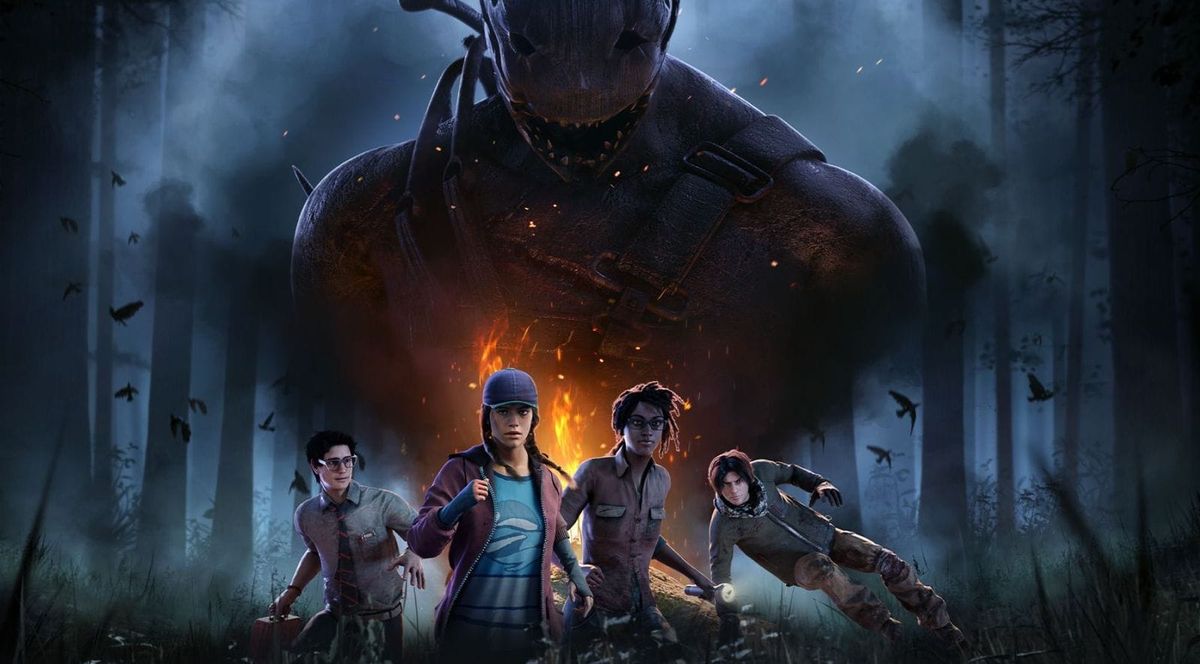
Dead by Daylight’s Killer vs. Survivor divide is bigger than an argument about which side is stronger. The game asks one Killer and four Survivors to experience the same Trial under radically different pressures, information, objectives, and definitions of success. That asymmetry makes balance difficult—and makes almost every major balance change feel unfair to somebody.
TL;DR — Behaviour has historically targeted roughly a 60% Killer kill rate, partly to preserve the Killer’s threatening role in a horror game. • Killer, Solo Queue Survivor, and coordinated SWF effectively experience three different versions of Dead by Daylight. • Tunneling, slugging, camping, gen rushing, body blocking, and perk stacking aren’t just etiquette arguments—they’re responses to the game’s underlying economy of time and pressure. • Recent attempts to reduce tunneling and slugging demonstrate the problem perfectly: protecting Survivors can unintentionally create new tools that coordinated teams exploit. • The real divide may be less Killer vs. Survivor and more individual pressure vs. coordinated information.
There is a moment almost every longtime Dead by Daylight player eventually experiences.
You finish a miserable match, stare at the post-game screen, and think: How can anyone possibly believe the other side is underpowered?
Then you switch roles.
Suddenly, some of those complaints make uncomfortable sense.
That contradiction has followed Dead by Daylight for years. And in 2026, after repeated attempts to address tunneling, slugging, generator pressure, matchmaking, and Survivor protections, the argument remains as fierce as ever.
The reason may be surprisingly simple.
Killer and Survivor players aren't merely playing opposite sides of the same game. Psychologically and mechanically, they're often playing different games entirely.
Why Is Dead by Daylight So Divided Between Killers and Survivors?
The Killer vs. Survivor divide exists because Dead by Daylight combines competitive PvP with deliberate asymmetry. Killers and Survivors don't share the same perspective, information, responsibilities, or even necessarily the same definition of winning.
A traditional competitive game can give opposing teams roughly equivalent tools.
DbD can't.
One player must threaten four. Four players must individually remain vulnerable while collectively possessing enough power to defeat that single opponent.
That creates an almost impossible balancing equation:
How do you make the Killer powerful enough to feel frightening without making individual Survivors feel powerless?
And the problem gets worse once skill and communication enter the equation.
| Scenario | Typical advantage | Why |
|---|---|---|
| New/low-skill lobby | Killer | Inexperienced Survivors waste resources and struggle in chases |
| Average matchmaking | Variable | Mistakes and builds can determine the Trial |
| Solo Queue | Often Killer | Coordination and information are limited |
| Skilled SWF | Survivor pressure rises dramatically | Communication makes objective management far more efficient |
| Elite Killer vs. elite team | Highly matchup-dependent | Killer choice, map, perks and execution become decisive |
This is why asking, "Is DbD Killer-sided or Survivor-sided?" rarely produces a useful answer.
Against whom? At what skill level? Using which Killer? On what map? And are those Survivors communicating?
Those details can completely change the answer.
Does Behaviour Intentionally Balance Dead by Daylight Around Killers?
Behaviour has publicly explained that it has aimed to keep Killers near a 60% average kill rate, rather than targeting an even 50% kill/escape split. The stated reasoning includes maintaining relatively even matches while preserving the horror fantasy of facing a dangerous Killer.
That number has become ammunition in the community war.
Survivor players can look at 60% and reasonably ask:
"If Killers are supposed to kill 60% of us, doesn't that mean we're supposed to lose?"
But kill rate isn't identical to match win rate.
A Trial ending with two deaths and two escapes, for example, contributes a 50% kill rate while commonly being interpreted as a draw. Three kills may be considered a Killer victory, while one kill generally isn't.
Even community attempts to convert kill rates into "win rates" demonstrate how assumptions about outcome distribution can radically change the resulting number.
There's another problem: averages hide matchmaking context.
Behaviour's 2026 statistics distinguish broad matchmaking from "High MMR," which it defined in that dataset as a rating of 1800 or higher—about 18% of the player base at the time the numbers were pulled.
That distinction matters.
A global average cannot tell you exactly what a new Survivor, elite Nurse, casual SoloQ player, or four-person veteran squad experiences.
Why Does Playing Killer Feel So Stressful?
Playing Killer concentrates virtually all responsibility for the match onto one person. You must find Survivors, win chases, track generators, remember resources, manage hooks, recognize perks, defend territory, and constantly decide whether another 20 seconds of chasing is worth the cost.
Nobody can rescue you from a bad decision.
Imagine you've chased a strong Survivor for 80 seconds.
You finally land the down.
Then:
BANG.
Generator completed.
BANG.
Another generator.
Maybe a third is already nearly finished.
You technically won the chase, yet emotionally it feels like you lost.
That is the Killer experience in miniature.
Why does one Killer mistake feel so expensive?
Killer gameplay operates on a brutal economy of seconds.
If four Survivors are alive, one can occupy your attention while three potentially advance objectives. The Killer therefore isn't simply trying to win individual chases—they're trying to make every chase cost less time than the Survivors gain elsewhere.
An extra loop around a pallet isn't merely an extra loop.
It might be another 15 seconds multiplied across several Survivor objectives.
This is why experienced Killers frequently abandon chases that casual players would continue. The real opponent isn't necessarily the Survivor running in front of you.
It's the clock.
Why Does Survivor Feel Unfair for Completely Different Reasons?
Survivors distribute responsibility across four players, but they sacrifice individual control. A Survivor can play exceptionally well and still die because teammates make poor decisions—or because the Killer decides eliminating that particular Survivor is strategically necessary.
That creates a different kind of frustration.
Consider a Survivor who waits through matchmaking, loads into the Trial, gets found first, chased, hooked, rescued, immediately chased again, and eliminated.
Their entire match might last only a few minutes.
From the Killer's perspective, removing one player early can be excellent strategy.
From the Survivor's perspective, they barely got to participate.
Both interpretations can be true simultaneously.
And that is one of DbD's deepest design problems.
Why Is Solo Queue So Different From Survive With Friends?
Solo Queue and coordinated SWF may technically use identical Survivor mechanics, but information changes their practical power dramatically.
A SoloQ Survivor may know that somebody is being chased.
A coordinated team can know:
"He's chasing me at main. It's Wesker. He used his power. Don't come here. Two people stay on gens. Someone else prep the save."
That's an enormous difference.
A coordinated squad can communicate Killer position, generator progress, perks, traps, totems, pallets, injuries and rescue intentions without sacrificing meaningful gameplay time.
Solo players must infer much of that information.
The three versions of Dead by Daylight
A useful way to understand the balance argument is to stop thinking about two factions.
There are effectively three:
Killer: a time-management strategy game where one person carries all responsibility.
Solo Queue Survivor: a survival game where teammates themselves are unpredictable variables.
Coordinated SWF: a cooperative information game where communication can erase much of that uncertainty.
Behaviour therefore faces a nasty balancing problem.
Buff Solo Queue too aggressively and those same tools can make coordinated Survivors even stronger.
Balance around coordinated teams too heavily and ordinary SoloQ players can suffer.
Buff Killers to handle exceptional squads and average Survivors may get crushed.
There is no clean lever to pull.
Why Are Tunneling, Slugging, and Camping So Controversial?
Tunneling, slugging and camping generate hostility because they reveal a conflict between strategic efficiency and player agency. Something can be tactically sensible for the Killer while simultaneously producing a miserable experience for the affected Survivor.
Tunneling
Tunneling means aggressively pursuing the same Survivor, particularly after an unhook, with the goal of eliminating that player early.
Why do Killers do it?
Because 1v3 is dramatically easier to manage than 1v4.
Why do Survivors hate it?
Because the targeted player can spend more time loading and hanging from hooks than actually playing.
Slugging
Slugging means downing a Survivor without immediately hooking them.
For Killers, slugging can create map pressure, prevent saves, counter nearby teammates, or pursue another vulnerable Survivor.
For the person lying on the floor?
It's downtime.
That's the fundamental disagreement.
One player sees pressure.
The other sees their controller doing nothing.
Camping
Camping creates the same conflict. Remaining near a hook can sometimes be strategically logical—especially when multiple Survivors are nearby.
But a Survivor staring at their hook timer doesn't experience the Killer's macro calculation.
They experience being prevented from playing.
What Happened When Behaviour Tried to Fix Tunneling and Slugging?
Behaviour's experiments with broader anti-tunneling and anti-slugging systems exposed exactly why these mechanics are so difficult to solve. Protections intended to prevent miserable Survivor experiences can become strategic resources when players deliberately exploit them.
Patch 9.3.0 provides an especially revealing example.
Following testing, Behaviour reverted the proposed unhook protections, Unique Hook bonuses, and slugging changes, while also reverting several related perk changes. (Dead by Daylight Support)
That's important.
It demonstrates that systemic fixes aren't as simple as "make tunneling impossible" or "let Survivors always pick themselves up."
Every protection changes the tactical equation.
If an unhooked Survivor receives extremely powerful protection, a coordinated team may intentionally use that protected player to obstruct the Killer.
If slugging becomes impossible, Survivors surrounding a downed teammate can potentially force the Killer into bad interactions.
But if protections are too weak, they fail to solve the original frustration.
Every anti-frustration mechanic can become a competitive resource.
That is the balancing trap.
Is "Gen Rushing" Just the Survivor Version of Tunneling?
In many ways, yes. Both terms describe players concentrating aggressively on their most efficient path toward victory, although "gen rushing" is often used loosely for ordinary efficient generator completion.
Survivors win by completing their objectives.
Killers win by preventing that long enough to secure sacrifices.
That creates a feedback loop:
Survivors complete generators efficiently → Killers feel forced to tunnel or run slowdown → Survivors feel forced to bring stronger chase and anti-tunnel builds → Killers feel forced into even stronger pressure.
Nobody necessarily entered the Trial intending to make it miserable.
They're adapting to what happened last match.
That's how metas become self-reinforcing.
How Did Dead by Daylight's Balance War Get This Bad?
The divide didn't appear overnight. Years of mechanical changes repeatedly shifted power between the two roles, teaching both communities to view balance patches defensively.
How powerful were early Survivors?
Early DbD was remarkably different.
Players eventually optimized mechanics that were designed for a far less competitive horror experience. Strong windows, old perk designs, powerful items and primitive counterplay could create situations that modern players would barely recognize.
As the community became better, Behaviour had to redesign mechanics around what players actually did—not what designers originally imagined they would do.
Why was Patch 6.1.0 so important?
Patch 6.1.0 represented one of DbD's major structural corrections.
Generator repair requirements increased, numerous perks changed, and Killers received broad baseline improvements.
Behaviour later reported that the average kill rate increased by roughly eight percentage points following the update, landing Killers in a range the studio described as deadly without being oppressive.
But solving one meta helped create another.
Regression combinations and generator-defense strategies became major community flashpoints. Behaviour subsequently continued adjusting perks including Dead Hard, Call of Brine, Overcharge and Pain Resonance in pursuit of greater build variety and healthier match pacing. (Dead by Daylight)
That's the DbD balancing cycle in one sentence:
Fix one pressure point, and players optimize whatever replaces it.
Is the Real Problem Dead by Daylight's Community—or Its Design?
The community certainly contributes to the hostility, but blaming everything on "toxic players" misses the deeper issue.
Dead by Daylight repeatedly creates situations where one player's rational strategy directly reduces another player's ability to participate.
That's fertile ground for resentment.
Consider these three situations.
Scenario 1: The early tunnel
Two generators finish during the Killer's opening chase. The recently unhooked Survivor remains injured nearby.
The Killer thinks:
"If I don't remove someone now, I'm losing."
The Survivor thinks:
"They ignored everyone else specifically to ruin my match."
Scenario 2: The coordinated hook save
The Killer finally downs somebody after a long chase.
Three Survivors arrive. One takes a hit, another blocks the route, and another prepares the rescue.
The SWF thinks:
"That was incredible teamwork."
The Killer thinks:
"I finally earned a down and the game won't even let me capitalize on it."
Scenario 3: Exit-gate taunting
The match is already decided, yet Survivors remain at the exit.
Maybe they're waiting to ensure teammates escape.
Maybe they want extra interaction.
Maybe they're teabagging.
From the Killer's perspective, ambiguity disappears quickly.
It feels personal.
And once competitive mechanics become interpreted as interpersonal disrespect, balance discussions stop being mathematical.
They become emotional.
Why Do Both Sides Remember Unfair Matches More Than Fair Ones?
Human psychology makes DbD's design even more combustible.
Players naturally remember painful losses more vividly than ordinary victories.
A Killer may play five normal matches and then encounter one brutally efficient coordinated squad. Which match are they discussing afterward?
Probably the sixth.
A Survivor might escape repeatedly, then get tunneled out immediately in the next Trial.
Which Killer do they remember?
The tunneler.
That selective memory creates distorted personal datasets.
Soon:
"I encountered a coordinated squad" becomes "Every Survivor is SWF."
And:
"I got tunneled three times tonight" becomes "Every Killer tunnels."
Neither player needs to be lying.
Their experience is real.
Their conclusion may still be wrong.
Does the 60% Kill Rate Prove Dead by Daylight Is Killer-Sided?
No single global kill-rate statistic can settle the balance debate. Behaviour has historically targeted Killers around 60%, but those numbers aggregate different Killers, player abilities, matchmaking brackets, team structures and match circumstances.
The statistic matters.
It just doesn't answer every question people ask of it.
Community-generated datasets present another challenge. NightLight and similar services can provide useful directional information, but voluntary datasets shouldn't automatically be treated as equivalent to Behaviour's complete internal telemetry. Even discussions on Behaviour's own forums regularly note those sampling limitations.
Players interested in their own performance now have another useful source: Behaviour's official Stats Tracker records kills, escapes, perks, character performance and recent match history, with statistics refreshed daily. (Dead by Daylight)
Dead by Daylight Official Stats Tracker
Can Behaviour Ever Actually Balance Killer, SoloQ, and SWF?
Perfect balance is probably unrealistic because these groups gain value from fundamentally different resources. Killer power depends heavily on time and pressure, Solo Queue suffers from uncertainty, and coordinated SWF converts communication into efficiency.
That doesn't mean improvements are impossible.
The healthiest direction is likely reducing information disparity and non-participation without eliminating strategic decision-making.
That means giving Solo Queue useful information without handing coordinated teams overwhelming additional advantages.
It means discouraging extreme tunneling without making an unhooked Survivor functionally untouchable.
It means reducing prolonged slugging without eliminating legitimate short-term slugging.
And it means ensuring Killers have meaningful ways to create pressure without requiring strategies that make one Survivor miserable.
Those are much harder problems than changing a perk percentage.
But they're the problems that matter.
Is Dead by Daylight Actually Supposed to Be Completely Fair?
This may be the uncomfortable question underneath the entire debate.
Dead by Daylight is simultaneously a horror game, competitive PvP game, party game, live-service progression game and asymmetrical strategy game.
Those identities don't always agree.
Horror wants vulnerability.
Competitive PvP wants fairness.
Survivor gameplay needs agency.
Killer fantasy requires power.
Casual players want variety.
Competitive players optimize everything.
Behaviour itself has connected Killer lethality with maintaining the horror theme, explaining that survival shouldn't feel guaranteed.
And that's where DbD differs from many competitive games.
The Killer isn't merely the other team.
The Killer is supposed to be the monster.
The problem is that the monster is controlled by another person who also wants a fair competitive experience.
The Killer vs. Survivor Divide Isn't Going Away
After years of playing, watching, and discussing Dead by Daylight, one pattern becomes difficult to ignore: the community keeps trying to solve a structural argument by declaring one side morally wrong.
Killers aren't inherently toxic for wanting pressure.
Survivors aren't inherently entitled for wanting meaningful time in the Trial.
A coordinated team isn't cheating simply because it communicates well.
A Killer isn't automatically malicious because they recognize that removing one player changes the match.
The real conflict starts when the game's most efficient decisions collide with somebody else's ability to enjoy the match.
That is why the Killer vs. Survivor debate survives every patch.
Behaviour can nerf a perk.
It can buff another.
It can redesign generators, hooks, recovery, matchmaking and Killer powers.
But it cannot completely remove the central tension without fundamentally changing what Dead by Daylight is:
One player hunting four people who are trying to escape.
Maybe that's why the argument has lasted so long.
The divide isn't sitting outside the game.
It's built into the Fog.
External Sources
Behaviour Interactive — 2026 Dead by Daylight Statistics — High-MMR definition and 2026 performance statistics. Accessed: August 17, 2026.
Behaviour Interactive — Killer Kill Rate Explanation — Developer explanation of the approximately 60% kill-rate target and horror-design philosophy. Accessed: August 17, 2026.
Dead by Daylight Patch 9.3.0 Notes — Official record of reverted tunneling, Unique Hook, and slugging changes. Accessed: August 17, 2026.
Dead by Daylight Official Stats Tracker — Official personal match and performance statistics. Accessed: August 17, 2026.
Author
Author: Zachery McKinney — Redacted Games
Zachery McKinney writes about games, player communities, mechanics, and the systems behind multiplayer experiences for Redacted Games.
Redacted Games Authority Note
Redacted Games examines games beyond patch-note summaries, focusing on how mechanics, communities, player behavior, and development decisions shape the games people actually experience.
{
  "@context": "https://schema.org",
  "@graph": [
    {
      "@type": "Article",
      "@id": "https://redactedgames.com/dead-by-daylight-killer-vs-survivor-divide/#article",
      "headline": "Dead by Daylight’s Killer vs. Survivor Divide: Why Both Sides Think the Game Is Unfair",
      "description": "An in-depth analysis of Dead by Daylight's Killer vs. Survivor divide, including kill rates, tunneling, slugging, Solo Queue, SWF and game balance.",
      "dateModified": "2026-08-17",
      "author": {
        "@type": "Person",
        "name": "Zachery McKinney"
      },
      "publisher": {
        "@type": "Organization",
        "name": "Redacted Games"
      },
      "mainEntityOfPage": {
        "@id": "https://redactedgames.com/dead-by-daylight-killer-vs-survivor-divide/"
      }
    },
    {
      "@type": "FAQPage",
      "@id": "https://redactedgames.com/dead-by-daylight-killer-vs-survivor-divide/#faq",
      "mainEntity": [
        {
          "@type": "Question",
          "name": "Is Dead by Daylight Killer-sided or Survivor-sided?",
          "acceptedAnswer": {
            "@type": "Answer",
            "text": "Neither label accurately describes every match. The practical advantage changes according to skill, Killer choice, map, Survivor coordination, matchmaking level and loadouts."
          }
        },
        {
          "@type": "Question",
          "name": "Why do Dead by Daylight players hate tunneling?",
          "acceptedAnswer": {
            "@type": "Answer",
            "text": "Tunneling can efficiently remove one Survivor, but the targeted player may spend most of the Trial being chased, hooked and eliminated with little opportunity to participate."
          }
        },
        {
          "@type": "Question",
          "name": "Why do Killers complain about SWF?",
          "acceptedAnswer": {
            "@type": "Answer",
            "text": "Coordinated SWF teams can communicate Killer location, generator progress, perks and rescue plans immediately, reducing the uncertainty Solo Queue Survivors normally experience."
          }
        },
        {
          "@type": "Question",
          "name": "What kill rate does Behaviour target in Dead by Daylight?",
          "acceptedAnswer": {
            "@type": "Answer",
            "text": "Behaviour Interactive has previously stated that it tries to keep Killers near a 60 percent average kill rate to support relatively even matches and the game's horror theme."
          }
        }
      ]
    }
  ]
}